building a better world for better living today...

The Bau-Green Method
"What Gets Governed Gets Protected. What Doesn't Gets Paid For."
Bau-Green Method Framework
How do actually govern a project?
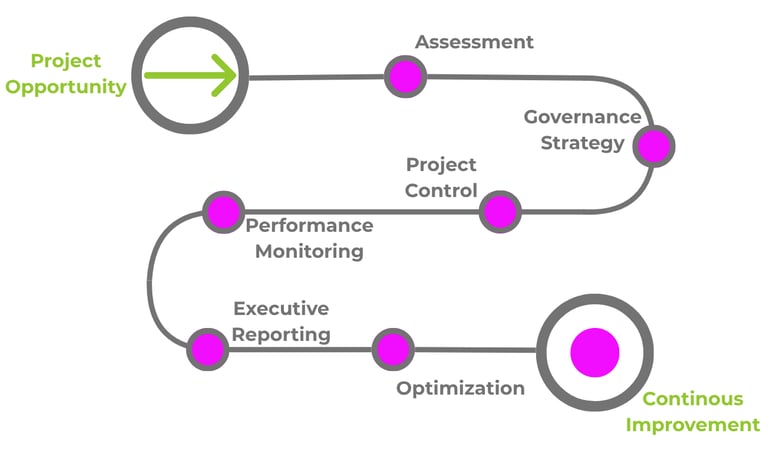
The Bau-Green Governance Methodology provides a structured framework for guiding construction projects from initial opportunity through completion and continuous improvement. Rather than relying on reactive decision-making, our methology establishes governance, accountability, and measurable controls at every stage of the project lifecycle.
Each phase builds on the previous one, creating a repeatable process that improves visibility, reduces uncertainty, and supports informed executive decisions.
A methodology is only as effective as the capabilities behind it.
Successfully governing a project requires more than following a sequence of steps. It demands specialized expertise, disciplined execution, and integrated project controls throughout the entire lifecycle.
The following six core capabilities form the foundation of the Bau-Green Governance Methodology and are applied continuously across every phase of every project.
The Six Core Capabilities

Budget Integrity
Establishing and defending the project budget against unauthorized spending
What we do:
Establish a formal budget baseline with clear cost categories and authorization levels
Review all contractor invoices against contract scope and budget before approval
Flag unauthorized spending or scope creep immediately (before it compounds)
Maintain transparent cost variance reporting (planned vs. actual, every month)
Control change order process — evaluate whether changes are legitimate vs. contractor scope creep
Why it matters: A single $50K unauthorized change order becomes $200K after cascading impacts. We catch these in week one. Budget discipline is capital protection.
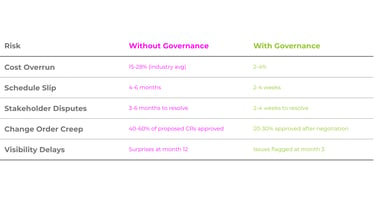
Real-World Impact: Most projects we've seen have 8-15 proposed change orders by month 6. Without governance, most get approved without scrutiny. With governance, 40-60% get eliminated or significantly reduced through clarification or contractor negotiation.

Schedule Control
Protecting timelines and identifying delays before they become crises
What we do:
Establish a baseline schedule aligned with project phases and stakeholder milestones
Track actual vs. planned progress (monthly or bi-weekly, depending on risk)
Identify schedule risks and delay drivers before they become critical
Coordinate contractor schedule submissions and validate feasibility
Escalate emerging delays to stakeholders with mitigation strategies
Why it matters: A 3-month delay costs far more than governance. We're watching for warning signs months before they become critical.
Real-World Impact: Schedule delays average 4-6 months on projects without governance oversight. With active schedule control, we typically identify risks 6-8 weeks in advance, allowing time for mitigation (extra crews, expedited materials, etc.). The difference: a manageable 2-4 week slip vs. a project crisis.

Risk Identification & Mitigation
Surfacing and managing threats to budget, schedule, and stakeholder outcomes
What we do:
Maintain a living risk register (budget risks, schedule risks, quality risks, contractor risks, regulatory risks)
Assess risk probability and impact quarterly
Develop mitigation plans for high-impact items
Escalate emerging issues to decision-makers immediately
Document decisions and outcomes for post-project learning
Why it matters: Most project disasters are visible 3-6 months before they blow up. We see them. You react. Problem averted.
Real-World Impact: Without governance, a contractor resource constraint (identified late) becomes a 3-month delay. With governance, we flag it at month 3, you bring in backup crews, and the project stays on schedule.

Stakeholder Alignment
Ensuring owner, contractors, and investors operate from shared understanding
What we do:
Attend key project meetings and coordinate between owner, GC, and subs
Document decisions with clear ownership and action items
Enforce contract terms and professional standards consistently
Mediate disputes before they escalate to legal (or delay the project)
Maintain a decision log so there's no confusion about "who decided what"
Why it matters: When stakeholders don't have shared understanding, miscommunication becomes disputes. When disputes escalate, they become delays and legal costs.
Real-World Impact: A scope ambiguity that could become an $80K legal dispute gets resolved in a 1-hour meeting with documented decision. No lawyers. No 3-month delay. Just clarity.

Executive Reporting
Providing stakeholders with transparent, actionable visibility into project health
What we do:
Provide monthly executive summaries (1-2 pages) of budget, schedule, and risk status
Create investor-grade scorecards showing KPIs (on track, at risk, delayed)
Report issues WITH mitigation plans (not just problems)
Make project data accessible in real-time
Document decisions for audit trail and post-project learning
Why it matters: Stakeholders can't act on information they don't have. Investors can't sleep at night if they're flying blind. We make project health visible and actionable.
Real-World Impact: An investor sees a monthly scorecard: "Budget: $10M, spent $3.2M, variance +1.2% (on track). Schedule: 40% complete, 6 months elapsed (on schedule). Risks: None escalated. Next milestone: structural completion, April 15." They have confidence. They can act rationally on change orders. They sleep.

Change Order Governance
Controlling the change order process to protect budgets from scope creep
What we do:
Establish clear change order procedures (what triggers a CR, who approves it, how it's priced)
Review all proposed change orders for legitimacy (true scope change vs. contractor scope gap)
Validate pricing and negotiate if necessary
Document changes and budget impact clearly
Maintain visibility into "pending CRs" so stakeholders know total exposure
Why it matters: Change orders are where budgets die. A contractor proposes 12 CRs totaling $300K. Without governance, you approve most of them. With governance, you approve 3-4 after negotiation. The difference: $200K protected.
Real-World Impact: By month 6 of a typical project, we've seen 8-15 proposed change orders. Our process usually identifies that 40-60% are contractor scope gaps (not true changes). We negotiate those down or eliminate them. The CRs that remain are legitimate and documented.

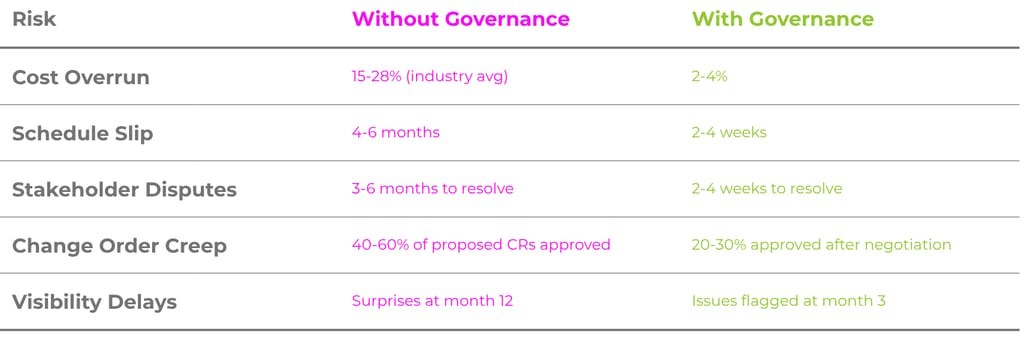
Every construction project carries risk — whether that shows up as cost, schedule, visibility, or contract exposure.
What governance does is turn those risks into structured control actions
How Governance Becomes Capital Protection.
The Math:
The Direct Owner Value:
✓ Stronger Cost Control — Budget overruns caught early, not late
✓ More Reliable Delivery — Schedule risk identified 6-8 weeks in advance
✓ Better Transparency — Stakeholders see real project health monthly
✓ Lower Overall Exposure — Fewer disputes, fewer surprises, fewer crises
Governance stops being "overhead support" and starts becoming real capital protection the moment you activate it.
Because in construction, what is not governed is eventually paid for.


building a better world for better living today...
Bau-Green Design + Construction, LLC © 2026. All rights reserved